Showing posts with label Editorial. Show all posts

Saturday, December 12, 2015

What are Carbon Neutral Publications & Can They Save You Money?


Click to launch the full edition in a new window.
As a designer and teacher I care deeply about all aspect of my course and how I present myself and my school to the world.

We have been printing an annual prospectus for nearly 20 years which I believe serves 3 distinct purposes.


  • The prospectus should be is well designed, after all; my students are signing up for a design course and will initially judge us, based on our presentation.
  • The information contained is clear, comprehensive and well laid out. Again this demonstrates attributes necessary to make a good designer and so any educational establishment should set a good example.
  • Potential students get to feel the weight and quality of the publication, This hopefully reflects the quality of the course itself, however it also probably only gets read a couple of times before being discarded.
This last point has been a concern to me particularly when we as designers, are dealing with environmental issues on a daily basis, but think I have found a solution in carbon neutral publication.

I pride myself on the fact that we as a college have always been a market leader in technology and innovation.

We were the first to introduce CAD and computer modelling into our curriculum and also to embrace internet technology and although not at the forefront, if compared to a .COM industry, we are light years ahead of our competition.


Since 2007 we have been using www.yudo.com an on-line publication service that gives you the look and feel of a magazine or book without the waste of paper and all the associated expenses.

It gives us the freedom to publish and update quickly, while virtually eliminating the need for publication budget.

2010/11 will be the first year we don't offer our customers a hard copy. We still produce a PDF version which is fast to download and hope that our public are ready to accept an electronic only option.

Your comments and thoughts would be much appreciated!
Technorati Tags: ,,,,


Tuesday, November 10, 2015

Garden Designer Interview: Duncan Heather

Thursday, October 24, 2013 at 10:18

In our series of interviews with garden designers that have a plethora of knowledge and talent, we at Notcutts were lucky enough to have caught up with one of Europe’s most successful garden designers, Duncan Heather.

Duncan Heather When reading Duncan Heather’s biography you can’t help but be impressed. He is one of Europe’s most successful garden designers, winning five gold, one silver and one bronze medal along with three best show awards for his work. Duncan trained under and worked for John Brookes – one of the most influential garden designers of the 20thCentury. In 1991 while working for Mr Brookes who is known for the world famous Denmans garden in West Sussex, Duncan was offered a directorship, something he declined in favour of concentrating on his own design practice in Henley-on-Thames.

Duncan splits his professional time working on a variety of garden design projects with lecturing at the Oxford College of Garden Design. He is the Founder and Principle of the college, since its inception in 1992, Duncan now offers a diploma course which can be obtained via online lectures, tutorials and video lectures.

We were lucky enough to catch up with Duncan to discover what it was like to train under and work with John Brookes, and what he believes is the key ingredient to a well thought-out and executed garden design.

What was it like to train under and work with John Brookes?

I rate John as one of the top designers of the 20th Century and he will go down in history as such. I was very privileged to be his design assistant and one of a handful of people to work with him. Working with him gave me a deeper insight into how his design philosophy (called Pattern Analysis) works, although he has written numerous books about design. It was this insight that helped me to set up Oxford College of Garden Design and reach the goals I wanted to achieve.

John developed ‘Pattern Analysis’, which is the polar opposite of the ‘SAD’ technique most garden designers are taught, allowing designers to create modern art within the garden.  The boundaries of the garden, act as a picture frame.  With the house always being the most important element of the design. An imaginary grid is setup, which is unique to the site and is created using the proportion of the house. As a result all the patterns created within the picture frame, relates back to the house in scale. The spaces within the design, can represent water, paving, lawn or planting and the lines dictate where a hedge set of steps or wall can be placed.

It sounds as though you have been extremely influenced by John Brookes, even mentioning his Pattern Analysis as a way of teaching. How does the Oxford College of Garden Design differentiate with ‘John Brookes: An introduction to garden design’?

John is no longer teaching a face to face course, but does teach a four-week online course with my sister school, MyGardenSchool . The classes I teach with Oxford College of Garden Design are intended to teach those who are wishing to become professional  garden designers, whereas MyGardenSchool aims to teach horticultural classes to the general public.

Both John and I co-wrote the classes taught at MyGardenSchool, and John is available to answer any questions, help with any design elements people may have and mark their work. He is very much involved in teaching and has embraced new technology throughout his career. We are both very excited about online learning, and I really believe this is the future; within a decade I believe all universities will be teaching their lectures this way.

You and Elspeth Briscoe founded MyGardenSchool  the world’s first virtual gardening school and you’ve also launched MyPhotoSchool. When you’re not lecturing how do you spend your time? I’ve noticed your garden is quite large, have you found time to do all the garden chores yourself?

My wife Carol, does most of the gardening, but yes I do a little work here and there. I tend to use my time to build and run my businesses, blog, do a little SEO and teach online. I am very lucky when it comes to how I spend my time. I love gardening and this is my full time job and photography is a great hobby of mine and I’ve been able to incorporate this into my work load too.  MyPhotoSchool was founded after our Flower Photography course proved to be the most popular class we had to offer and since then we have been able to ask top photographers to teach at our online school.

Following your article ‘Would you be a better Landscape Designer if you were Dyslexic?’ and being dyslexic yourself, do you believe it has made you a better designer?

Those with dyslexia tend to see things more holistically. We’re more arty than analytical. Do I think it has made me a better designer? I think it has helped. I struggle less with visualising what I want to do. When I walk into a garden, within half an hour I have a clear plan of what I intend to do with that space.

What do you believe to be the key ingredient to a well thought out and executed garden design?

The house and site are the main factors for every garden design. What a lot of people believe is the most important aspect of garden design is the client, but what I want to create is a garden  with longevity. Although the client is important, after all they are paying the bill, you also need to ensure the next owners like the garden too. It has to work with the house and location. The style and location of the house needs to be put at the forefront of any design, whether it is a countryside setting or in a more urban environment. The architecture is the main focal point; it is the beginning and end of all design. The design then has to revolve around it.

What influenced your garden? Are there places you like to source inspiration from?

I have a two acre garden, which is located in a heavily woodland environment. One part of my garden is filled with beach woodland which makes it difficult to grow anything, not even brambles could grow under the trees due to the lack of light. So in the second part of my garden, I removed 60 of the trees and create two woodland glades. One is grass and the other is a natural duck pond.

What inspires me is light. When you walk into a church with beautifully painted stain glass windows and they catch the light it can be breathtaking, and often makes the hairs on your neck stand up. This is what I have created in my garden with mounded flower beds (two to three feet high); it’s wonderful to see plants with a natural back light. This height, or having the border westerly faced, ensures that you can create shafts of lights. When I walk through my garden, I will get a different feel at all times of the day. Playing with light quality inspires me and if a designer gets it right, you can create shadows that dance on the grass and take the art of design to another level.

Do you think Chelsea Flower Show is a good place to start pulling ideas for your garden if you’re a novice?

To me the Chelsea Flower Show is a complete waste of time. The RHS are not going to like what I say, but I feel it’s the same old designers, techniques and gardens just rehashed year upon year. It is dated and irrelevant.

I always suggest to my students that they go to the International Garden Festival at Chaumont-sur-Loire in France. Each year 30 gardens are built by architects, designers or anyone who is artist and not bogged down by planting. They create mind blowing art installations within hedged exteriors that are not large in scale, but gigantic in artistic flare. They use sound, light, water, reflectivity, shadow and mirroring to create something that pushes the boundaries in design.

Trees seem to take centre stage in your garden; what do you look for when buying a young tree?

I take a look at the roots to make sure it is healthy and prefer pot bound trees. I look out for a good, strong trunk that is damage free and has a good head of branches with two or three leaders, and often opt for trees with 8-12cm to 16-18cm girth. I prefer to plant young trees as they don’t need as much TLC as mature trees and tend to get away more quickly. 

What advice can you offer those wishing to build a magical garden from scratch?

Take your time; a garden isn’t like a house and you can complete the build over the course of many years; but do have a master plan to work with. If you don’t feel you have the qualifications to draw up a plan, bring someone in to help you and don’t be afraid to gain help in building your garden.

Although this is a cliché, the garden is an extension of the home, especially now as we can incorporate the outside sofas and art. I use photography in my garden to create an art installation; experiment with different ideas. Segregate parts of the garden with natural walls or use meshing with photographs for a modern twist; this is especially great for urban environments. Light control is also great to experiment with as you can create all sorts of atmospheres.

What does the magic of gardening mean to you?

In the spring time I love to go outside, sit on my deck with a glass of wine and listen to the birds singing. There is nowhere else I’d rather be and my wife and I never chose to travel in April because of this.

The garden is the most magical retreat and if you get it right you can create a real oasis. In urban environments you can use the sound of water to mask on-going traffic or add screens to create privacy. When you sit in your garden the pace of life changes, your quality of life improves in this space you’ve created

 

Tuesday, September 1, 2015

The Design Process

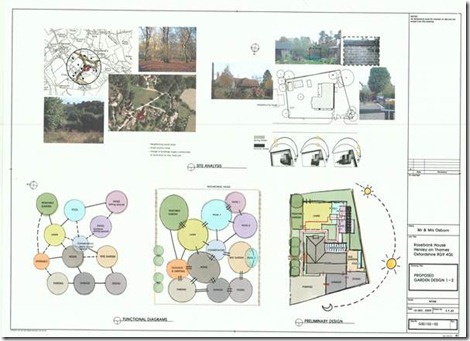
Designer Duncan Heather argues that more can be made of the preliminary research documents, when it comes to winning design contracts and selling schemes to clients.

clip_image002

When first being taught to allocate space, the landscape student is guided through several different processes before they reach a final design solution.

It all starts with an accurate topographical land survey. A plan of the site is then drawn up to scale, to include boundary walls, existing buildings, trees, services and existing levels.

Having gathered this information on a local scale, the student should then expand their area of study to the surrounding landscape. Topographical, historical cultural and architectural information can be gathered from maps and the internet, which helps put the site into context and may suggest a theme on which to hang their eventual design.

Shadow plans are then calculated to assess the impact of spring and summer shade patterns and a sight Analysis plan developed to note the influencing factors of the site such as existing features, wind direction good and bad views etc.

Once all this information has been compiled, the student can start to experiment with space allocation in the form of bubble or functional diagrams.

All this work is a prerequisite to the creation of the presentation or master plan.

But what happens to all this research once the presentation plans are completed?

What many student fail to appreciate, is the difficulty many clients have in understanding the 2D plan drawings.
While we take it for granted that the ‘house’ is the big black rectangle in the middle of the drawing, it’s surprizing how few clients realise this. You can be waxing lyrical about how great their new garden is going to be, while showing them the plan and they simply can’t make head nor tail of it!

At the Oxford College of Garden Design we teach our students to overcome these difficulties by using the research and preparation drawings as part of the sales presentation.

The diagram above, illustrates the 4 preliminary design stages and can either be presented on separate sheets, or combined into one or 2 presentation drawings. These allow the designer to start their presentation, by going through the site survey and pointing out the house and the important features of the garden. This allows the client time to digest the plan and to familiarise themselves with the graphical nature of the drawings.

Next you can explain how you developed their ideas, by running through the site analysis plan and the bubble/functional diagrams.

Explaining the thought process to your clients helps you justify why you have arrive at a particular design solution, but also it help the client to understand how much work goes into the preparation of a landscape plan.

When you are charging several $1000 for an outline proposal arriving with just one sheet of paper can give the client the impression that they are not getting value for money.

Remember! you only get one crack of the whip at presenting your ideas, so you need to make that ‘sale’ in no more than about 60 minutes, otherwise you won’t get the rest of your design fee and more importantly the garden will never be built.

Arriving with 2-3 sheets of research drawings plus the garden plan, plus any coloured perspective and a mood board, suddenly starts to look like a lot of work and thought has gone into the design.

So if you want to improve your sales and get more of your gardens built, spend a little extra time ‘prettying-up’ your research drawings and use them as part of your presentation.

Duncan Heather is director of the Oxford College of Garden Design and MyGardenSchool and one of Europe top garden designers

Saturday, February 28, 2015

The Society of Garden Designers; a damp squib washed up on the shores of mediocrity.

iStock_000008599764Small-1
Are so called professional body; the Society of Garden Designers, has forced through what I consider to be the worst piece of legislation in its pitiful 30 year history.
It has decreed that from 2010, if you want to apply to become even a lowly corresponding member you have to submit work before a panel of your peers to be weighed, measured and no double found wanting!
Its bad enough having to apply for full membership in this patronising and archaic fashion, but to expect potential probationary members to go through this as well is frankly bonkers.


It doesn’t take a genius to realise that the whole membership thing is in a mess.  Why is it that the membership ratio of full members to corresponding has never risen much abou 1-10.
That’s right;  after 30+ year there are only about 180 full members of the society in the whole world!  This despite consecutive councils trying their best to up the numbers.
Councils discuss the same things and make the same mistakes time in, time out, like some giant horticultural ground hog day.
They think by vetting the ‘newbie's’ and putting a 2 year time limit on them to apply for full membership they will improve things. 
Far from it! I predict the membership will fall further and the organisation will become even more redundant than it already is.
In any other professional organisation, education is the route to full membership.  Surveyor, engineer, architect, all have to have a first degree before they can apply.
Unfortunately the SGD has been too much of a coward to go down this route, because so many of the founding members have a vested interest in the lucrative garden design education market.
Take away the corresponding members and you don’t have a viable membership.  So the Society  has become little more than a Surrogate training centre for sub- standard design schools.
It’s not until students have completed one of these lesser courses, that they realise how poor their training has been, only to be taken up by the SGD’s seminar program which in itself is a poor substitute for proper tutorage.
Instead of this controversial adjudication panel, I propose the SGD introduce and examination.  This could then be sold to the schools and colleges at a profit and would weed out those courses not capable of passing it.
The colleges could then use there exam marks as a guide to the quality of the course.
If they still wish to have a period of professional practice before full membership then so be it, but stop this lunacy before more of us give up on you and don’t renew our memberships.

Friday, February 27, 2015

Buying Wholesale Plants: Tips & Tricks

    One of the hardest things to source as a newly qualified garden/landscape designer is a good supplier of trade plants.  I never buy from Garden Centres as I consider them too expensive (Plants  can have a 200% mark-up on them) 

    So here are my top ten tips, I tell my students for sourcing and buying plants from trade nurseries.

    12

    1. To buy from trade nurseries you must be a trade customer. While some nurseries offer both retail and wholesale, most trade nurseries do not accept orders from the public, so be prepared to provide proof of your trade status when you first make contact.

    2. Always visit a nursery in person before ordering from them for the first time.  Many trade nurseries would want you to make an appointment to visit them rather than you just turning up on spec. Check to see how clean and tidy the nursery is, as this is often a good indication as to how good their plants are.  If the nursery is untidy or has weeds growing in the pots or in the display aisles, this is not a good sign and indicates a certain level of neglect.

    3. You often have to order a minimum number of each plant, usually that’s 10 or more of the same variety.

    4. In the industry we have 2 levels of plant quality, landscape and garden centre quality. For private gardens you must use garden centre quality plants and I would always stress at the time of order, that I will only accept the very best and will reject anything that is not us to scratch. With some nurseries I would prefer to hand pick my plants in order to guarantee the standard, and suggest until you know and trust your nursery you do the same.

    5. Don’t be afraid to reject substandard plants, but this does mean you have to be present when the order is delivered, so they are returned on the same lorry as they arrive. The nurseries will very quickly realise that you can’t be fobbed-off with poor quality stock.

    6. Herbaceous perennial plants grow and mature very quickly so order P9 size plants where possible (small square pots) rather than 1-2 litre pot size.  This means you will need to order them in good time and collect your plants in early spring before the nurseries start potting up.  If you don’t, you could end up with a plant costing twice as much and all you get for your money is a larger pot and more soil.

    7. Buy plants at the right time of year.  I personally don’t like planting herbaceous plants in autumn as they don’t have long enough to get established before they go dormant for the winter.  This may result in a much higher mortality rate.  Instead I prefer to plant in spring, when I can see the young plants actively growing and they have a whole season to get established.

    8. Some plants are only available at certain times of the year.  Grasses have traditionally been most abundant in nurseries from August through to October, and are much harder to get in the spring as most of the stock will have been sold the previous year and new stock takes time to grow.

    9. Plants that take longer to mature i.e.shrubs and trees should always be purchased as large as possible.  I prefer to buy semi mature shrubs to give my borders an instant sense of maturity.  The money I save on buying small herbaceous plants can be spent on larger shrubs.  Semi mature trees are cheap!  You can buy an 8m Beach or Oak for between £250-£400  Don’t buy garden centre size trees as it may be decades before your garden looks like the way you intend it to look.

    10. Use plants you know you can get hold of!  It’s no good specifying a rare plant that only one nursery in the world grows and then, only propagates 10 a year, because the chances are they won’t be available when you need them.  I use my nursery catalogues to choose the plants that I want and I try to order as early in the season as possible to ensure they have not run out of stock.  If they have, then I always choose the substitutes.  Most nurseries will offer substitutes, but a good designer will always go back to the drawing board and redo the plan with available stock.

        To see a list of trade nurseries I use in the UK click here

      Monday, February 16, 2015

      Carol’s Garden of the Month (January)

      Anglesea Abbey01CR2

      Well I am writing this with my PC perched on my lap staring out at a winter wonderland which some 3 weeks ago was my garden .  It is hard to imagine right now that it will ever re-emerge!

      Certainly this snow and the icy temperatures will have taken their toll and present new challenges when it loosens its grip!!!!

      So I confess that this month’s garden comes from good memories rather than a recent visit!!!

      So my friends my “must see” once weather conditions allow is The Winter Garden at Anglesey Abbey created some 30 years ago around about the time of our last truly “icy grip”!

      Anglesea Abbey03CR2

      My enduring memory of my visit is walking along the meandering path that flows through this comparatively modest space(1 acre) staring in wonder at the amazingly intense colours produced at such a mean time of year in the plant world!. It was almost as if the plants were giving off heat!

      Anglesea Abbey05CR2

      You could if you wanted to be unkind and describe the planting as a little dated, Yew,Leyland cypress Viburnam, Daphne Euonymus ,Ericas and Conifers might be considered a blast from the past and seriously unsexy today but mixed with an amazing selection of Cornus the planting simply glows and could never fail to excite!

      Anglesea Abbey06CR2

      Towards the end of the walk are the famous Betula under planted with Bergenia and I defy anyone not to be impressed by these! Oh yes and stop to “sniff” as there is perfume to be had too! So I say there is no such thing as dated planting only planting that does or doesn’t work and this is definitely the ethos adopted by the OCGD

      Anglesea Abbey08CR2 .

      Check opening times and try to go on a sunny day so that the Cornus and Bergenia in particular are illuminated by the low slanting sunlight to make the best of those backlit photo opportunities and how could you resist the ubiquitous shot of the white stemmed birch and those fiery Bergenia leaves!!

      Anglesea Abbey18CR2 At this time of year it will feed your soul!!!!

      Anglesea Abbey09CR2

      Anglesea Abbey12CR2 

      Would you be a better Landscape Designer if you were Dyslexic?

      whole-brain

      Like most people who find something difficult, I dislike writing intensely, but with my job, it’s an inevitability that has to be endured.

      I must confess to being very Dyslexic.  I can’t spell for toffee; never could; and probably never will!

      So why  am I so grateful to be dyslexic  and why would that make me a better designer?

      First you have to ask your self, are you a left or right-brain person?

      As an artist, you might think right, if you're an accountant, you might think left.

      In reality, it's not really an either/or situation. Because each half of the brain tends to control certain kinds of thinking, its easy to categorise people as either one or the other.

      Left Brain characteristics tend to be, Logical Sequential, Rational, Analytical, Objective.

      While Right Brainers’ are considered Random Intuitive, Synthesizing, Subjective and Holistic

      But while some people tend to use one side of the brain more than the other, the reality is that the two sides are dynamic and interactive.

      When most of you are thinking and learning at your peak, you use your whole brain, switching freely between the halves.  Dyslexics however tend to favour the right side over the left.

      Traditional education has been overly focused on left-brain modes of thinking. Logic, sequences, and rote learning have been pushed, and the more creative "big picture" has been marginalized.

      This is true for design teaching as well and may account for the sorry state of most student end of year exhibitions. 

      Look in most design/architecture books and you still see the old Survey, Analysis, Design or SAD method of teaching predominate.  SAD because it often produces  very SAD looking work .

      At the Oxford College of Garden Design I teach the way I would have wanted to be taught myself. We study two styles of Design. The traditional SAD process and John Brookes’ Pattern Analysis.

      Pattern Analysis is the polar opposite to SAD.  It looks at shape and pattern based on geometrical theory and allocates the paces and lines with different materials.

      As a dyslexic designer i don’t think about space allocation but art and pattern.  I visualise the site as a whole, while creating a series on interlocking geometric shapes, then allocating each with one of the following materials: paving, lawn, water, or planting.

      Pattern Analysis could easily be mistaken in the early stages of the design process, for a piece of modern art, such as that created by the 20th century French artist Mondrian. 

      The following video is an series of extracts from some of our lectures on design.

      You will see the importance of understanding pattern and how shapes link together. 

      Finally we will reverse engineer two courtyard gardens to discover their underlying patterns and how they were created.

      You may wish to watch the 800x600 version of this on Vimeo to fully appreciate the lesson

      Please leave feed back here or feel free to ask questions.

      Monday, February 9, 2015

      Can People Find your Website? See our new video tutorial to maximise your business in 2010

      At the Oxford College of Garden Design we believe good business is as important as good design, so from day one, we start preparing our student to set up and run their own design business (see DG700).

      This video, (part of our new interactive online training program), is really useful, for anyone who wants to improve their web page rankings. Called Search Engine Optimisation (SEO) by following these simple steps you can significantly increase your web presence.  We explain why its important to blog, Twitter, and use social media like Facebook, MySpace and LinkedIn.  

      This is probably the most important video tutorial you will watch this year! so if you have found it useful please tell other people where to find it by clicking on one of the social networking links in the top right corner of this blog.

      Wednesday, February 4, 2015

      15 English Winter Gardens to See in 2010

      Anglesea Abbey18CR2
      1 Anglesey Abbey, Cambridgeshire 
      Has one of the best modern winter garden in the UK, planted in 1998, it takes you past a stunning array of white-stemmed birches, dogwoods, ghostly brambles (Rubus cockburnianus), Mahonias, Christmas box and Viburnums. Wed-Sun, 10.30am-4.30pm, closed December 21-30; £4.20/£2.10; 01223 810080, www.nationaltrust.org.uk
      2 Regent’s Park, NW1
      Regent’s Park, which covers 410 acres and has a lake, formal and wildlife areas, woodland and open parkland. To its west is a winter garden with heathers and shrubs such as Viburnums and Cornus,. 5am-dusk; free; 020 7486 7905, www.royalparks.org.uk
      3 Thames Barrier Park, E16
      The 22 acres of riverside gardens are a delight.. 7am-4.30pm; free; 020 7476 3741,www.thamesbarrierpark.org.uk


      4 Bedgebury Pinetum, Kent
      This is the most complete collection of conifers in the world, covering 350 acres. 8am-4pm, closed December 25; free, parking £7.50; 01580 879820,www.forestry.gov.uk/bedgebury

      5 The Royal Landscape, Surrey
      The 1,000-acre Royal Landscape includes the Savill Garden, the Valley Gardens and Virginia Water. The new winter walk at the Savill Garden will be ready next year; 10am-4.30pm, closed December 25 and 26; free in December;01784 435544, www.theroyallandscape.co.uk .
      Anglesea Abbey05CR2 6 Sir Harold Hillier Gardens, Hampshire
      The collection includes 12,000 species and cultivars of trees and shrubs, as well as a colourful winter garden.. 10am-5pm, closed December 25 and 26; £8.25/free; 01794 369317, www. hilliergardens.org.uk
      7  Stourhead, Wiltshire
      Neoclassical temples around an 18th-century landscape garden and lake are sublime. 9am-dusk; gardens £6.30/£3.40, estate free; 01747 841152,www.nationaltrust.org.uk
      8 RHS Rosemoor, Devon
      The winter garden is full of colour, provided by heathers, conifers, grasses and willows, as well as trees and shrubs chosen for their form and interest at this time of year. 10am-5pm, closed December 25; £6/£2; 01805 624067, www.rhs.org.uk
      9 Eden Project, Cornwall
      Apart from the biomes, there’s plenty to see outside, too: mass plantings of willows, dogwoods and rubus line the slopes of the former clay pit, Times vary, closed December 24 and 25 and January 12 and 13; £15/£5; 01726 811911,www.edenproject.com
      10 RHS Hyde Hall, Essex
      The winter border and the Lower Ponds are the main focus of interest, but the long views over the surrounding Essex farmland also appeal. 10am-4pm, closed December 25; £5;01245 400256,www.rhs.org.u k
      11 Royal Botanic Gardens, Kew, London
      2010 sees the 250th anniversary of the gardens, adults £13/children free; 020 8332 5655, www.rbgkew.org.uk
      12 Stowe, Buckinghamshire
      The landscape gardens around this Robert Adam mansion, currently being restored, drip with classical allusions, including temples, statues and a grotto. With the likes of Capability Brown, Charles Bridgman, William Kent and John Vanbrugh involved, they could not fail to be spectacular. Gardens, Sat and Sun, 10.30am-4pm; £6.20/£3.15; 01494 755568, www.nationaltrust.org.uk . Parkland open daily, dawn-dusk; free
      13 Trentham Gardens, Staffordshire
      The 750 acres of gardens and Capability Brown-designed park have been regenerated in the past five years.The formal Italianate garden, laid out by Sir Charles Barry, architect of the Houses of Parliament, has been revived Tom Stuart-Smith and Piet Oudolf. 10am-4pm, closed December 25; £5/£3.50; 01782 646646,www.trenthamleisure.co.uk
      14 Tatton Park, Cheshire
      There’s plenty of choice in the 50 acres of gardens at Tatton Park, from the Edwardian Japanese garden to the pinetum, maze, lakes and fernery, housed in a 19th-century conservatory designed by Joseph Paxton – not to mention the 1,000-acre deer park. Tue-Sun, gardens 11am-4pm, park 11am-5pm, closed December 25; £4/£2 (NT and RHS members free), parking £4.50; 01625 374435,www.tattonpark.org.uk
      15 Belsay Hall, Northumberland
      The Grade I-listed Victorian and Edwardian gardens include a former quarry with a microclimate that lets exotic trees and shrubs survive outside, and a winter garden featuring mahonias, viburnums, conifers and scented heathers. The yew topiary looks glorious dusted with frost. Thu-Mon, 10am-4pm, closed December 24 and 26 and January 1; £6.40/£3.20; 01661 881636,www.english-heritage.org.uk