Showing posts with label palms. Show all posts

Monday, March 2, 2015

Ponytail Palm Plant Care

Common Name: Ponytail Palm
Scientific Name: Beaucarnea Recurvata
Lighting: Bright Light
Watering: Moderate to Low


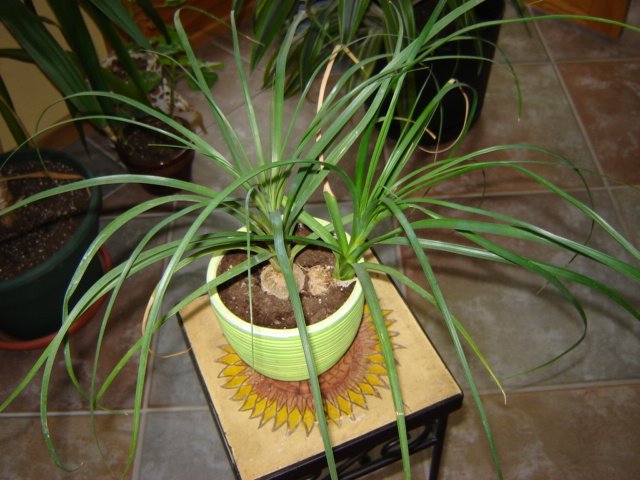
Ponytail Palm

Ponytail palms get their name from their ponytail like appearance. The Ponytail palm is one of my top 10 easy to grow houseplants. It requires very little attention. The only downfall to the Ponytail palm is that it is an extremely slow grower, so don't expect great growth spurts from year to year.


The Ponytail palm should be watered thoroughly once every 7 - 14 days. The Ponytail palm is native to desert areas therefore, it has a root system similar to cactus in that the roots go deep in order to store water for long dry spells. Be sure to let the soil become dry to touch 1" to 1-1/2" deep before watering again. If you notice the lower foliage is starting to turn a yellow or brown color you may be under watering the plant. The Ponytail palm requires bright light so be sure to place it near a window where full sun is received.


Bugs and mites usually are not a problem with the palm, however if they do appear, simply spray the houseplant down with a soapy water mix twice a day until they are gone.


Thursday, February 26, 2015

Sago Palm Care

Sago Palm

Common Name: Sago Palm
Scientific Name: Cycas revoluta
Lighting: Moderate to Bright Light
Water: Low


The Sago Palm is characterized by its plastic like foliage. The green, feather-like branches of the Sago Palm make it a great addition for any room. This houseplant is a great plant to start out with for beginners. The most interesting thing about the Sago Palm is that it really isn't a palm. It is a Cycad. Sago Palms (cycads) are a group of plants that lived during prehistoric times. Cycads are a long-lived group of plants so with little attention your plant should last a very long time (many years).


The Sago Palm prefers bright light, but will also tolerate moderate levels as well. Try to keep the plant near light or else new growth will dramatically lean towards the light. It also is a good idea to turn the plant slightly every couple of days to keep the plants shape.


You should allow your Sago palm to dry out in between waterings. If you are successful at growing cactus, watering this houseplant can follow the same schedule. Their watering also should follow according to the amount of light they receive. If it is placed in an area with lower light levels, you may only need to water it every couple of weeks. If matured foliage begins to yellow you are probably over watering the plant.


This houseplant is pretty hardy. It doesn't seem to have a real temperature preference and do not have any humidity requirements. During dry months, a daily misting may add some extra lift to your plant. The only downfall to this houseplant is that they are extremely slow growers; so do not be discouraged if your plant doesn't appear to be growing.


One downfall to this gorgeous palm, is that it is poisonous to animals and humans. Like so many other plants, it is included in the list of poisonous houseplants.


Please share your comments and experiences with other readers.


Tuesday, February 24, 2015

Majesty Palm Care

Common Name: Majesty Palm
Scientific Name: Ravenea rivularis
Lighting: Moderate
Water: Low to Moderate


The Majesty Palm is characterized by tall stalks of bladed green foliage. The Majesty Palm is a common houseplant. This palm adds beauty and class to any room. The Majesty Palm prefers medium light so keep within 5 to 8 feet of a window. In my experience, this palm seems to do well in a partially shaded area as well.


Watering of the Majesty Palm is crucial. The plant must have proper drainage set up. Do not allow the roots to sit in water. On the other end, do not allow the plant to dry out completely in between waterings either. This palm also prefers a slightly higher humidity level, so a daily misting will add plenty of beauty to your plant.


If the foliage tips begin turning brown, you are probably under watering the plant. Try watering it more often. On the other hand, if the foliage tips begin turning yellow, you may be over watering it.


A common pest to this plant is spider mites. If problems with pests appear, try misting the plant with a soapy water mixture twice a day. If spider mites still appear try a more powerful spray available from your local gardening store.


Share some of your tips and tricks that have helped you with this plant.


Phoenix Palm Plant Care

Common Name: Phoenix Palm
Scientific Name: Pigmy Date Palm
Lighting: Moderate
Water: Moderate to Low


The Phoenix Palm is characterized by light arching feather-like fronds in dark green color. The Phoenix Palm looks similar to the Kentia Palm except the Phoenix foliage is smaller in width and daintier in appearance. This palm is usually a very good indoor houseplant which requires little care.


Phoenix Palms grow best in bright, indirect sunlight, so place within 3 to 5 feet of a window, preferably an east window. If plant begins to show yellow or black spot on the foliage, try moving it further away from the window. It may be receiving too much direct sunlight and actually be burning the plant.


The Phoenix Palm prefers to stay moist, however do not let the plant stand in water. Usually a good thorough watering once a week is sufficient. If your plant begins to droop, chances are you are under watering it. If you continue to under water you plant, the plant may never return to its normal shape and appearance. If the tips of the foliage begin to turn black or yellow, you are probably over watering your palm. Reduce how often you water. Usually wait until soil is dry to touch 2 inches deep. Like most palms, this plant prefers higher humidity levels, therefore a misting a couple times a week is good.


If new growth is damaged, sometimes it can be very difficult to get your palm back to its original healthy appearance. You may prune off the tips if they have turned yellow or black to help the plants appearance along.


Please share your experiences and tips by commenting below!!!


Neanthe Bella Palm Care

Common Name: Neanthe Bella Palm, Parlor Palm, Good Luck Palm
Scientific Name: Chamaedorea elegans
Lighting: Moderate to Bright
Watering: Moderate to Heavy


The Neanthe Bella also known as a Parlor or Good Luck Palm, typically grows indoors to between 2 to 6 feet in height. Neanthe Bella Palms are very durable houseplants and can be enjoyed for many years.  This palm is one of the most popular choices for an indoor houseplant. 

The Neanthe Bella Palm prefers medium to bright light so a north or west facing window will be best for placement. Do not keep your palm in direct sunlight as it may burn the foliage.

Neanthe Bella (Parlor or Good Luck) Palms need to have their soil moist at all times.  These palms do not do well when allowed to completely dry out or being overly soggy.  Aim to water your Parlor Palm at least once a week to begin with and adjust accordingly to how the soil feels.  This palm can be picky when it comes to water.  Be sure to use non-fluoride water for this plant.

Pests are typically not a problem with this palm any more than other houseplants.  Spider mites may appear. If pests appear, try my home remedy that really hasn't failed me, of spraying the plant twice a day with a soapy dishwater mixture. If that does not work, go to your local gardening center and they can instruct you on which product to use.

It would be beneficial to give this plant some fertilizer on a regular basis.  I typically use a general indoor houseplant fertilizer added to the water once a month.  If you notice the frond tips beginning to brown, try fertilizing once every two months as it could be receiving too much.  


Monday, February 23, 2015

Chinese Fan Palm Care

Common Name: Chinese Fan Palm
Scientific Name: Livistona chinensis
Lighting: Bright Light
Water: Heavy


The Chinese Fan Palm has distinct foliage, which looks just as the name sounds. Large, bright green fan-shaped leaves radiate from their own small stalks. The Chinese Fan Palm requires more space than your average houseplant due to the large foliage it supports as well as its spread.


This houseplant prefers full sun, so keep within 3 feet of a window which receives sunlight for at least 4 to 5 hours. Be sure to also keep the plant away from heat and cooling sources such as vents or doors so that it maintains a consistent temperature. Your Chinese Fan Palm will also enjoy a daily misting of water to help satisfy its humidity requirements. If the leaf tips turning brown, you probably are not keeping the humidity levels high enough.


Another main area to watch for with this houseplant is its water level. The Chinese Fan Palm requires heavy watering, so be sure to keep the soil moist at all times, but at the same time, do not over water. You don't want the soil to become soggy. Soggy soil is always a good candidate for root rot.


I personally have never had any problems with bugs or disease with my Chinese Fan Palm, however spider mites can be common with this houseplant. If bugs appear on your plant, simply mist with a soapy water mixture twice daily until gone.


This plant is a slow grower, so don't feel discouraged if it seems its size is remaining constant.


Lady Palms Care

Common Name: Lady Palms
Scientific Name: Rhapis species
Lighting: Bright Light
Watering: Moderate to Low


Lady palms are very adaptive thus their popularity as a houseplant. Lady palms foliage is characterized by thick green leaves with blunt tips radiating from the center of a stem. Picture your hand with your fingers spread out. The stems are covered with a brown fiber. Lady palms as a houseplant are slow growers. Outdoor varieties grow at a much faster rate.


There are many varieties of Lady Palms. Here are some of the most popular:
Thailand Lady Palm - Rhapis subtilis
Large Lady Palm - Rhapis excelsa
Miniature Lady Palm - Rhapis excelsa
Laos Lady Palm - Rhapis laosensis
Slender Lady Palm - Rhapis humilis


Lady palms prefer bright, indirect light so keep within 3 to 5 feet of a window. Variegated varieties require lower light levels. This houseplant is not very picky about its temperature or humidity. So normal indoor temperatures should suit these plants.


Lady palms prefer to dry out in-between watering however the Thailand Lady Palm (Rhapis subtilis) prefers to be moist at all times. This houseplant like many others is extremely touchy when it comes to water. Use un-treated water containing no fluorides or chlorine. If the tips of the leaves brown, the water may not be pure enough or you may be over fertilizing the plant. You can trim the brown tips off, just keep the leaves same shape when doing so.


If the entire leaf is browning it could be due to one of many causes. One is that the plant is not receiving enough water. Another common mistake is that the plant has been placed to close to a draft or heat source.


Scale insects are main pest for this houseplant however can be hard to identify and get rid of. The best method is using an insecticide which is absorbed through the roots. Visit your local garden center to find the right product.


Areca Palm Care FAQs

Problem
How often should I water my Areca Palm?

Answer
Areca Palms prefer high water levels so keep the soil moist at all times. The soil should be kept moist but not soggy. Be sure your pot allows for proper drainage by putting 2 inches or more of pebbles at the bottom of the pot as well as a water tray. The foliage of your Areca palm will tell you if the plants needs water. If the leaves droop, close-up or dry up then the palm probably needs more water.

In winter months, like many other houseplants, Areca Palms require less water. Areca Palms also prefer high humidity levels, so running a humidifier or a daily misting will be beneficial too.

Brown, then black, leaf tips are caused by salt build-up in the root zone. Cut off the black tips, but realize that the salt in the root zone is causing the problem, and you need to flush them out with lots of water, outside, where they can dry out and you can do it again, and again. Or transplant them into new soil mix. Tolerate the burn until the weather warms up, if you live where it's cold.


Problem
Can Areca Palms be split into multiple plants?

Answer (Courtesy of Denis)
Clustering palms can be propagated by dividing the root ball. Seeds are the normal way, but for indoor plants, dividing them is the easiest. Trim them back to a few healthy stems, because damaged roots will reflect back in the head leaves, so don't expect a weaker root system to support the many leave stems it had before.


Problem
How much light does my Areca Palm need?

Answer
Areca Palms prefer full sun, so keep your palm within 3 to 5 feet from a window receiving 4 to 5 hours of sunlight. East and West windows are good choices for this lighting requirement.

Remember Areca Palms are not dark green normally, but when in dark areas, all plants increase the amount of chlorophyll in their leaves to help get the most out of the minimum light. Yellow green is the color of a happy Areca's leaves, with plenty of light (Golden cane palm).


Problem
Do you have any tips on pruning an Areca palm?

Answer (Again courtesy of Denis)
You can save a lot of worry and prayer by doing a simple test on almost any plant, to see if it is viable. Using a fingernail, or some small knife, remove a bit of the outer tissue of the stems (bark) and check for green tissue, underneath. If there is none, the stem is dead; remove that stem or cane.

In fact, a distressed plant is better off with less leaf mass to support. If sick, 90% of plants will show it, and "you can tell".

If a plant was exposed to freezing temperatures long enough for the water in the cells to freeze, the ice formation will expand and break the cell walls, generally killing that section. Leaves can come back, but not on dead canes or stems. Root cells can survive more easily because the earth around them has to freeze first.

Generally, the best thing you can do for a sick plant, is give it a "haircut". Cut it back and you relieve the stress; keep cutting until you get to green tissue. Simpler, you can see if the stem bends; if it is dead, it will snap and break. This is true for roots too. Remove the dead tissue (that snaps) and keep the top area proportional to the remaining root mass. New stems should come up from a living root system.

You may not want to have the plant in your living room after it is cut back; put it someplace where it can rest and recover, --if the roots are alive. With few or no leaves, it needs little light or water. Too much water can induce rot, and cool, wet conditions cause fungi to thrive. Once new leaves start to emerge, gradually bring it back to some sunlight.

Healthy areca palms have a yellow tint, as they are not shade plants and do not need as many chlorophyll cells. The house plants we like, are usually natives of the under-canopy (jungle) world, where they produce wide leaves saturated with chlorophyll cells to compete for the available light.
Water: The leaves will close to reduce water loss area, first, so that signals their stress.


Problem
How do I cut off dead or browned branches on my Areca Palm?

Answer
Snip the dead branch where it meets the soil. Just cutting the ends or dead portion off will not help the palm; it may actually stunt your plants growth. Pulling the frond from the root is also not a good way. Doing so you may disrupt the other roots and do more damage.


Problem
My Areca Palm is infested with some sort of pest. How do I get rid of it?

Answer
Whatever the type of pest (scale, mites, spider, fungus, etc.) I always try my homemade remedy first. Mix together some soapy dishwater (water and dish soap), spray the entire plant twice a day for a few days. If you are seeing improvement, then continue for at least one week. If the pest doesn’t seem to be going away, local garden center for a pesticide safe for houseplants.


Problem
My Areca Palm looks sickly and isn’t doing well. What could be the problem?

Answer
With a sick palm, remove canes where the crown pulls out, then remove the dead, rotting roots. It’s easy to tell if you have any living roots that aren't rotten yet, from fungi. Sniff test will confirm if they are rotten. Remove all the dead tissue, top to bottom, and re-pot in new clean mix. Do not give the plant any fertilizer or houseplant food until new growth has started.

You can use Hydrogen peroxide to determine if it’s a fungi problem. In the crown of palms, Hydrogen peroxide will bubble when it hits fungi protein. The same is true for the roots. The Hydrogen Peroxide won't hurt the plant, but will kill fungi. The bubbling will stop when no more fungi is present.
Without good drainage, plants will drown and even faster if during the winter months. Fungi will spread more quickly in an over watered plant. Adding some vinegar to the water will keep the soil slightly acidic and kill residual fungi. You can check pH with pool or aquarium test paper.


Miscellaneous Tips

Remember, that when you transplant any type of houseplant, many will go through a down period due to shock. The shock from the transplant will cause the houseplant to look worn out, even yellow for a short time period. Usually within a month, your houseplant will be back to normal.

Additional tips from the always knowledgeable, Dennis:
They are tough, 27F doesn't bother them, surprisingly, and like most plants, will decline if given too much "care".

Cold temps will "burn" them and the look resembles heat burn, as the cell tissues are burned by heat transfer, in or out. Once the tissue is burned, get rid of it because it becomes a target for disease or fungi. Palms only grow from the crow of each stem, so when the crown dies, that whole stem will never recover, so cut it off. Once the plant, any plant, is damaged, it goes into shock and stops growing. Never fertilize a sick plant, or over water it!

Stems that are too long will bend, normally. Tie them together with green nursery tape or cut the big ones down.

Be sure to also read the complete Areca Palm Care post for detailed information on how to care for this houseplant.
Kentia Palm Care

Common Name: Kentia Palm, Sentry Palm, Thatch Leaf Palm
Scientific Name: Howeia Forsteriana
Lighting: Moderate
Watering: Moderate


The Kentia Palm is characterized by a series of arching feather-shaped fronds radiating from small trunks in a dark green color. Kentia Palms are slow growers so do not expect mass growth. On the other end, they are very durable house plants and therefore can be enjoyed for many years.


Kentia (Sentry, Thatch Leaf) Palms are not tolerable to severe dryness or continual over watering. They prefer to be moist much of the time, however do allow the top 1 to 2 inches of soil to dry before watering again. If frond tips are turning brown and the fronds are droopy, you are probably not watering the plant enough. On the opposite side, if the leaf tips are yellowing then becoming brown, chances are you are over watering the palm. The Kentia, like many palms, is extremely sensitive to chemicals in the water. Therefore be sure to use untreated water for this house plant and all your palms.


The Kentia palm prefers bright, indirect light but will also tolerate lower light levels. In lower light levels the plant's appearance will seem fine; however it just won't quite have the healthy look preferred. If you notice spotting on the upper fronds, the plant may be getting too much bright light, so try and move it to an area with a lower amount of direct sunlight.


Pests are usually not a problem with this house plant. Spider mites may appear. If so, try my home remedy that really hasn't failed me, of spraying the plant twice a day with a soapy dishwater mixture. If that does not work, go to your local gardening center and they can instruct you on which product to use.


Please share you tips on this common houseplant!!


Areca Palm Care

Common Name: Areca Palm
Scientific Name: Chrysalidocarpus lutescens
Lighting: Moderate to Bright
Watering: Heavy


Feather-like green fronds radiating from several trunks characterize the Areca Palm. This houseplant is beautiful when new, however overtime the Areca Palms attractive appearance can diminish slightly. Fronds when bigger may droop and bend over. The Areca Palm is a slow grower. It will grow wider before taller.


Tips of the Areca Palm may also turn brown. The browning tips of the palm are normal. All of the Areca Palms that I have had, the tips did turn brown eventually. One main area to beware of with this palm is that you should only prune off dead branches. If you clip the browned tips you will stop the growth of that branch.


Requires bright indirect light so keep it within 5 to 8 feet from a sunny window. If put in too much direct light, the fronds may get burnt from the sunlight. When a frond becomes yellow or dead like in appearance be sure to remove the entire frond.


The Areca Palm requires heavy watering; however do not allow the plant to sit in water because this could lead then to root rot. The Areca Palm will wilt drastically if you allow the soil to dry out completely. On a good note, once you water it, the plant will stand back up. This houseplant is extremely sensitive to salts and minerals, so if your home uses a water softener, water from a source that does not go through the softener first, such as an outside faucet. As most tropical plants, an occasional misting will make your plant look and feel healthier.


A common pest to this plant is the spider mite. If the appearance of spider mites is present, try misting the plant twice daily with a soapy water mixture. If this does not work, go to your local plant or hardware store and try a professional grade pest remover.


Overall this plant requires a great deal of attention to maintain its beautiful appearance. However with its majestic like appearance and ability to fit into any decor all the work may be a great payoff.


Please feel free to share your comments and experiences with this plant.