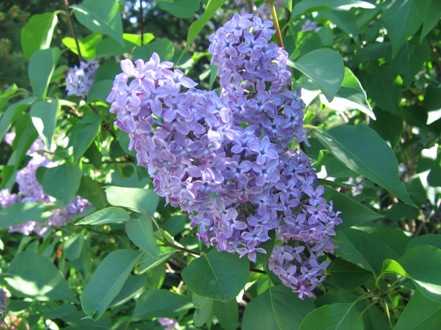
Around there, the Lilacs (
Syringa vulgaris) are in full bloom. Just a short walk outside and their perfumed scent hits you before your eyes can even find them. But what does it mean if the shrub doesn't bloom? I was asked this question last weekend by a friend. Last year she pruned it serverely after it flowered, with the hopes of rejuvenating it so it would be overflowing with blooms the following spring. However, this year, not one bloom appeared.
There are a few reasons I can think of as to why a Lilac shrub wouldn''t bloom:
1. Pruning
New flower buds are formed soon after the current year's blooms die back. To ensure abundant flowering the next year, spent blossoms should be cut off and the flowering stem should be pruned back to a set of leaves. Waiting too late to prune will remove the new buds that have formed for the following year.
2. Immaturity
Most varieties of Lilacs need three to four years to grow and develop before they produce their first blooms.
3. Soil pH
Lilacs prefer sweet soils (slightly acid to alkaline) with a pH between 6.0 and 7.0. If the soil is too acidic (aka "sour"), it should be amended with lime to help sweeten it a bit.
Never assume your pH - have it tested by your local garden center or Cooperative Extension Service before trying to alter it.
4. Fertilizer
In general, Lilacs don't need much fertilizer, but if you feel it is needed, Cornell University recommends a 5-10-10 (5% Nitrogen, 10% Phosphorus, 10% Potassium). Using the wrong type of fertilizer can be a problem. Fertilizers with higher Phosphorus will encourage flowering on plants and vegetables. Fertilizers with higher Nitrogen will help produce green leaves, but will hinder blooming. Apply fertilizer to the planting area in the spring, as new growth is beginning.
5. Sunlight
Lilacs need full sun. If the shrub is in partial sun or shade, it will not bloom well.
6. Water
Lilacs need do not like wet feet, so be sure they are not over-watered. They do best in soil that is well drained.
7. Transplant shock
If the plant was moved since the last blooming period, it may take a year for it to recover and be happy.
Did you know?
The story of Lilac, according to Greek mythology, begins with a beautiful nymph named Syringa (Lilac's botanical name). Captivated by her beauty, Pan, the god of the forests and fields, chased Syringa through the forest. Frightened by Pan's affections, Syringa escaped him by turning herself into an aromatic bush - the flower we now refer to as lilac!